



Wake up.
Check the phone.
Get ready.
Commute.
Work.
Answer messages.
Attend meetings.
Solve problems.
Check notifications.
Return home.
Handle responsibilities.
Scroll.
Sleep.
Repeat.
For many people, modern life feels less like living and more like continuously catching up.
There is always another task.
Another message.
Another deadline.
Another expectation.
Another reason to hurry.
But slowing down does not necessarily mean becoming less ambitious or productive.
Sometimes it simply means becoming more intentional about where your attention goes.
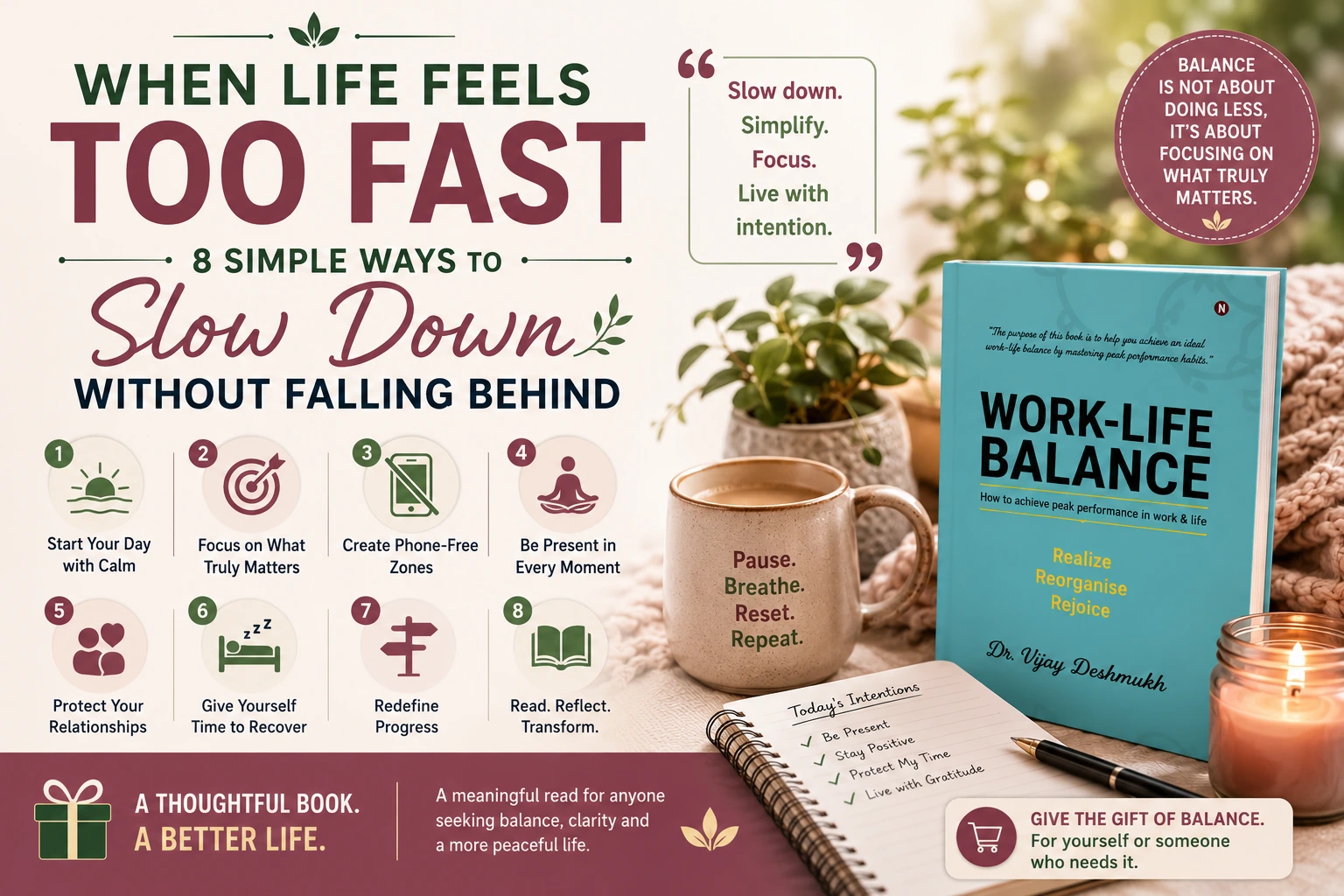
Here are eight practical ways to create more balance without abandoning your responsibilities.
1. Stop Starting Your Day with Everyone Else’s Priorities
Your phone gives the outside world immediate access to your attention.
If your first morning activity is checking messages, email, social media, or news, you begin the day responding to everyone else’s priorities.
Try protecting the first 15–30 minutes.
Drink water.
Stretch.
Sit quietly.
Think about your priorities.
Read.
Take a short walk.
Starting calmly can change the emotional tone of the entire morning.
2. Decide What Actually Matters Today
A long to-do list can create the illusion that everything is equally important.
It isn’t.
Choose the two or three things that genuinely deserve your attention.
Completing meaningful priorities often creates more satisfaction than completing fifteen insignificant tasks.
Slowing down is partly about doing less of what doesn’t matter.
3. Create Small Phone-Free Zones
You do not need to abandon technology.
Create boundaries around it.
For example:
- No phone during meals.
- No work email during family time.
- No social media for the first 30 minutes after waking.
- No unnecessary notifications.
- No phone beside the bed.
These small boundaries can reclaim surprising amounts of attention.
4. Be Where You Are
Have you ever been eating dinner while thinking about work?
Or sitting in a meeting while thinking about another task?
Or speaking with someone while looking at your phone?
Our bodies may be in one place while our minds are somewhere else.
Practice giving full attention to the current activity.
When working, work.
When eating, eat.
When listening, listen.
When resting, rest.
Presence makes ordinary experiences richer.
5. Protect Relationships from Busyness
One of the hidden costs of a rushed life is reduced connection.
Relationships require time, but they also require attention.
Ask someone how their day was—and actually listen.
Call a friend without needing a reason.
Spend an uninterrupted hour with family.
Small moments of genuine connection often contribute more to happiness than another hour spent completing low-value tasks.
6. Give Yourself Permission to Recover
Rest is not laziness.
Recovery supports performance.
Sleep, exercise, hobbies, reading, meditation, quiet walks, and unstructured time can help the mind recover from continuous stimulation.
You do not need to “earn” every moment of rest through exhaustion.
Sometimes resting before you become exhausted is the wiser choice.
7. Redefine What Progress Looks Like
Progress does not always mean doing more.
Sometimes progress means:
Saying no.
Sleeping properly.
Repairing a relationship.
Reducing unnecessary commitments.
Learning to manage stress.
Taking better care of yourself.
Becoming calmer.
Choosing what truly matters.
A balanced life may look less impressive from the outside while feeling far more meaningful from the inside.
8. Read Something That Changes Your Perspective
A thoughtful book can temporarily remove us from the speed of everyday life and encourage reflection.
For readers struggling with professional pressure and competing responsibilities, Work Life Balance: How to Achieve Peak Performance in Work and Life by Dr. Vijay Deshmukh offers a relevant perspective.
The book follows Rajan and Tina, an ambitious working couple whose fast and competitive lifestyle begins affecting their health and personal relationships.
Through their journey, the book explores stress management, peak performance, and the intelligent management of professional, family, personal, social, and spiritual dimensions of life.
The underlying idea is simple but important:
Life works better when achievement and well-being are not treated as enemies.
You Don’t Need to Escape Your Life to Improve It
When people feel overwhelmed, they sometimes fantasize about completely changing everything.
Leaving the job.
Moving somewhere quiet.
Deleting every application.
Escaping responsibility.
Occasionally major change may be necessary.
But often, meaningful improvement can begin with smaller adjustments.
Twenty phone-free minutes.
One meaningful conversation.
A better bedtime.
A short meditation.
A protected weekend morning.
One unnecessary commitment removed.
One hour spent doing something you genuinely enjoy.
Small changes can gradually alter the rhythm of everyday life.
Balance Is Personal
There is no universal formula for a balanced life.
A young entrepreneur building a company may temporarily spend more time working.
A parent with young children may prioritize family.
Someone recovering from exhaustion may prioritize health.
Someone approaching retirement may prioritize relationships and purpose.
Balance changes with circumstances.
The important question is not whether your life looks balanced to someone else.
It is whether your current priorities reflect what genuinely matters to you.
📘 A Thoughtful Read for a More Balanced Life
Work Life Balance: How to Achieve Peak Performance in Work and Life
By Dr. Vijay Deshmukh
If life feels constantly rushed, the book can offer useful perspectives on professional performance, stress, relationships, and creating a more balanced approach to success.
Buy Work Life Balance on Amazon
It can also make a meaningful gift for a busy professional, working partner, entrepreneur, colleague, or someone entering a demanding new phase of life.
Final Thoughts
Slowing down does not mean giving up on progress.
It means deciding what deserves your speed.
Some things deserve urgency.
Others deserve patience.
Your career deserves effort.
Your relationships deserve presence.
Your body deserves recovery.
And your mind deserves moments when it is not constantly processing the next task.
You do not necessarily need more hours in the day.
You may simply need to become more intentional with the hours you already have.
Because a meaningful life is not created only by how much we accomplish.
It is also created by how deeply we experience the life happening while we accomplish it.
FAQs
How can I slow down when I have a demanding job?
Start with small boundaries such as protected morning time, phone-free meals, clearer priorities, and dedicated recovery periods.
Does slowing down reduce productivity?
Not necessarily. Reducing distractions and unnecessary activity can improve focus and help you spend more energy on meaningful priorities.
What book can help me understand work-life balance?
Work Life Balance: How to Achieve Peak Performance in Work and Life by Dr. Vijay Deshmukh explores stress, performance, relationships, and balanced living.
Is Work Life Balance suitable as a gift?
Yes. It can be a thoughtful gift for busy professionals, entrepreneurs, working couples, leaders, or anyone seeking a healthier relationship with achievement.
