



Some of the most powerful subjects in poetry are also the most ordinary. The fragrance of soil after rain. A daughter loved deeply by her family. Mehndi on someone’s hands. A city filled with old memories. A relationship that never found a name. A dream waiting for its wings.
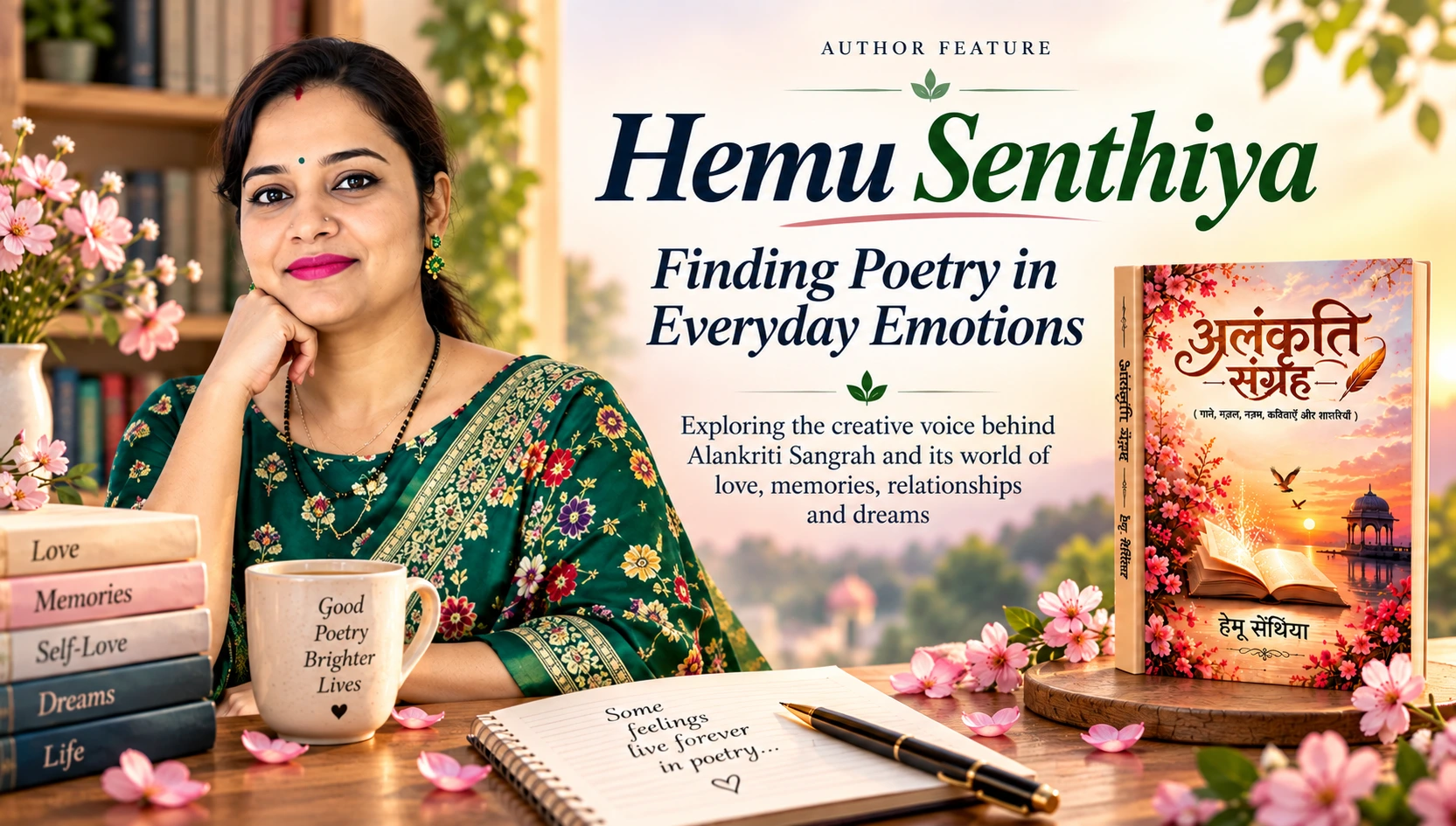
These moments may appear simple, but each can carry an entire world of emotion. That emotional world sits at the heart of Hemu Senthiya’s (हेमू सेंथिया) Hindi poetry collection, अलंकृति संग्रह (Alankriti Sangrah). Bringing together “गाने, ग़ज़ल, नज़म, कविताएँ और शायरियाँ”, the collection moves through love, relationships, memories, family, self-love, dreams, nature and social consciousness. Rather than building its identity around one emotion alone, Alankriti Sangrah explores the many feelings that accompany everyday life. And through these themes, readers are introduced to the creative voice of Hemu Senthiya.
Meet Hemu Senthiya
Hemu Senthiya is the author of Alankriti Sangrah, a Hindi literary collection encompassing different forms of poetic expression. The collection itself provides the clearest introduction to her creative world.
Its themes move from Mitti Ki Khushboo (मिट्टी की खुशबू) and Laado (लाडो) to Yaadon Ka Shehar (यादों का शहर), Swayam Se Prem (स्वयं से प्रेम), Benaam Rishta (बेनाम रिश्ता) and Sapno Ki Udaan (सपनों की उड़ान).
Taken together, these subjects reveal a broad interest in the emotional experiences surrounding everyday life. There is affection. There is nostalgia. There are complicated relationships. There is introspection. There are dreams. And there is an awareness of the world beyond one’s personal emotions. Instead of separating these experiences, Alankriti Sangrah allows them to exist together—much as they do in life.
Finding Poetry in Everyday Life
Poetry does not always begin with extraordinary events. Sometimes it begins with noticing. A familiar fragrance suddenly reminds us of home. An old photograph makes a forgotten moment vivid again. A bird outside the window creates thoughts of freedom. A particular place becomes inseparable from someone we once knew.
The event itself may be small. The feeling attached to it may not be. This relationship between ordinary experiences and deeper emotions appears repeatedly among the themes of Alankriti Sangrah. Mitti Ki Khushboo can evoke soil, rain, roots and belonging. Chiraiya (चिरैया) can invite thoughts of tenderness, freedom or flight. Mehndi (मेंहदी) may bring memories of traditions, celebrations and relationships. These are familiar images, particularly within Indian life. Their familiarity is precisely what can make them effective poetic subjects. Readers already know the image. Poetry invites them to rediscover the emotion inside it.
Love Without Simple Definitions
Love is among the oldest themes in poetry, but human relationships rarely fit perfectly into simple definitions. Some relationships are clearly understood. Others remain somewhere between friendship, affection, longing, memory and silence. This emotional ambiguity is reflected in titles such as Ek Tarfa Mulakaat (एक तरफा मुलाकात) and Benaam Rishta (बेनाम रिश्ता). The idea of an ek tarfa mulakaat—a one-sided encounter—immediately creates questions.
What did that meeting mean? Was something felt but never expressed? Did the moment end while its memory continued? Similarly, a benaam rishta—a nameless relationship—suggests a connection that may matter deeply despite resisting a conventional label. These are precisely the emotional spaces where poetry can become powerful. Ordinary conversation often wants definitions. Poetry can allow uncertainty to remain. Not every feeling needs to be resolved. Sometimes it only needs to be recognised.
When Memories Become Poetry
Memory has an unusual relationship with time. Something that happened years ago can suddenly feel close because of a song, a fragrance, a place or a familiar voice. This makes memory an endlessly rich subject for poetry. Yaadon Ka Shehar—the city of memories—is an especially evocative idea. The city we remember is not necessarily the city that exists on a map. Our personal city is made of people. A particular road.A favourite corner. A conversation. A celebration. A goodbye. A place where something important happened.
The physical location may change, but the emotional version survives within memory. This is one reason poetry about familiar places can feel intensely personal even when the writer and reader have never visited the same city. The poet creates the idea. The reader fills it with their own memories.
Mitti Ki Khushboo: When a Fragrance Becomes an Emotion
Few sensory experiences are as evocative as fragrance. Unlike a photograph, which shows us a particular image, a familiar fragrance can bring back an entire atmosphere. Mitti Ki Khushboo is therefore an interesting poetic theme. For one reader, the fragrance of earth may mean the arrival of rain. For another, it may recall childhood.
For someone living far from where they grew up, it might mean home. For another person, it could evoke fields, family or a particular season. The physical experience is simple. The memories attached to it can be enormous. Poetry often works in exactly this way—using something tangible to reach something emotional.
Family, Affection and the Meaning of Laado
Among the themes in Alankriti Sangrah, Laado carries a particularly warm emotional association. In many Indian families, Laado is an affectionate way of addressing a beloved daughter. But a single word can carry much more than its dictionary meaning.
It can contain childhood memories. Parental affection. Protection. Pride. Growing up. And eventually, perhaps, the complicated emotions that accompany change and separation. Family emotions often work this way. We do not necessarily express them through grand speeches. They appear in names, habits, traditions and small acts of care. Poetry can take those familiar expressions and give readers an opportunity to recognise their emotional significance.
Mehndi: Where Tradition Meets Memory
Mehndi is another seemingly simple subject capable of carrying several layers of meaning. It can be beautiful visually, but its associations often extend much further. Weddings. Celebrations. Festivals. Family gatherings. Friendships. Anticipation. Love. Tradition. For different readers, the same image may unlock completely different memories.
This is an important characteristic of emotionally accessible poetry: it leaves enough room for the reader to enter the experience. A poet may begin with mehndi. A reader may end up remembering an entire chapter of their own life.
Swayam Se Prem: Turning the Poetic Gaze Inward
Poetry about relationships often focuses on how we feel about other people. But Alankriti Sangrah also includes Swayam Se Prem—स्वयं से प्रेम, or love for oneself. That shift inward is significant. Self-love can be misunderstood as self-indulgence or constant positivity.
In practice, it can involve something much quieter. Understanding yourself. Recognising your emotional needs. Accepting imperfections. Respecting your boundaries. Allowing yourself to change. And refusing to measure your entire worth through other people’s approval. Including self-love alongside romantic, family and social themes broadens the emotional landscape of the collection. It suggests that the relationship we have with ourselves also deserves reflection.
From Self-Reflection to Sapno Ki Udaan
Human beings do more than remember. We imagine. We hope. We create versions of tomorrow that do not yet exist. Sapno Ki Udaan (सपनों की उड़ान) introduces this aspirational side of the collection. The phrase itself carries movement. Dreams are not simply present—they are being given wings. That idea can connect with readers in many different ways. A dream may mean education. A career. Creative expression. Independence. Travel. Love. A peaceful life. Or the courage to begin again. The specific dream may be different for every reader, but the desire to move towards something meaningful is widely shared.
Pyara Sa Swapn and the Softer Side of Hope
Where Sapno Ki Udaan suggests aspiration and movement, Pyara Sa Swapn (प्यारा सा स्वप्न) carries a softer emotional quality. Not every dream has to be enormous. Some of life’s most meaningful hopes can be remarkably simple. A happy family. A peaceful home. A meaningful relationship. Time to pursue something creative. A life lived with dignity. A moment we wish could last longer. Poetry can give these quieter dreams importance. It reminds us that ambition does not always have to be loud.
Poetry That Looks Beyond the Individual
One particularly interesting part of the thematic range of Alankriti Sangrah is Nagrik Bhavna (नागरिक भावना). Its inclusion takes the reader beyond purely personal emotions and towards civic consciousness. This matters because poetry has never belonged exclusively to love and heartbreak. It can also examine community, society, responsibility, belonging and our relationship with the world around us. The personal and the social do not have to be separate.We can care deeply about individual relationships while also thinking about the society in which those relationships exist. The presence of Nagrik Bhavna therefore adds another dimension to the collection’s emotional range.
The Many Forms Inside Alankriti Sangrah
The book describes itself through the words: “गाने, ग़ज़ल, नज़म, कविताएँ और शायरियाँ” That combination is important to understanding the collection.Rather than restricting itself to one mode of poetic expression, Alankriti Sangrah brings multiple forms together. Songs can introduce rhythm and musicality. Ghazals and shayari have long been associated with compressed emotional expression.
Nazm allows ideas and emotions to unfold differently. Poems provide another flexible space for reflection and storytelling. Together, these forms allow the book to move across moods rather than maintaining one continuous emotional tone.
What Hemu Senthiya’s Themes Tell Us About Her Creative Voice
It is important not to confuse literary interpretation with personal biography. A poem does not automatically tell us that every event happened directly to its author. What we can examine, however, are the subjects a collection chooses to explore. In Alankriti Sangrah, those subjects repeatedly return to emotion, relationships, memories, family, familiar cultural imagery, self-reflection, dreams and social awareness.
That gives Hemu Senthiya’s published collection a recognisable thematic identity. It is a poetic world interested in what people feel. How they remember. How they relate to one another. How they understand themselves. And how ordinary experiences acquire emotional meaning.
Why Familiar Emotions Matter in Literature
Readers do not always search for literature because they want to escape into something unfamiliar. Sometimes they want recognition. They want to encounter a sentence and think: I know this feeling.
That moment of recognition creates a connection between reader and writer. A poem about an unnamed relationship may remind someone of a person they never knew how to describe. A poem about memories may reopen a forgotten chapter. A poem about self-love may arrive when someone needs to hear it. A poem about dreams may encourage another reader to continue. The writer provides words. The reader brings experience. Meaning emerges somewhere between them.
Poetry in a Fast-Moving World
We live in an age of extraordinarily fast communication. Messages arrive instantly. Videos last seconds. Social feeds refresh continuously. Yet speed does not necessarily make emotional communication easier. We may exchange more words than ever while still struggling to express certain feelings. This helps explain why poetry continues to matter.
A poem asks us to stop. Read. Feel. And sometimes read again. It can take an experience we have rushed past in real life and return our attention to it. That makes collections centred on everyday emotions particularly relevant. The world may move quickly. Human feelings often do not.
The Reader Completes the Poem
One of the beautiful things about poetry is that its meaning does not belong exclusively to the writer. Readers participate. Consider the phrase Yaadon Ka Shehar. One person may imagine their childhood town. Another may think about college. Someone may remember a city they left after marriage. Another may think about a place connected with someone who is no longer part of their life.
The words remain the same. The emotional landscape changes with every reader. This is why poetry can become deeply personal without being written specifically for us. We recognise ourselves inside someone else’s words.
Alankriti Sangrah at a Glance
Book: Alankriti Sangrah (अलंकृति संग्रह)
Author: Hemu Senthiya (हेमू सेंथिया)
Language: Hindi
Category: Poetry & Shayari
Literary Forms: गाने, ग़ज़ल, नज़म, कविताएँ और शायरियाँ
Themes: Love, Relationships, Memories, Family, Self-Love, Dreams, Nature & Social Consciousness
Who May Connect with Hemu Senthiya’s Writing?
Alankriti Sangrah may interest readers who enjoy:
- Hindi poetry and shayari
- Ghazals and nazm
- Writing about love and relationships
- Nostalgia and memories
- Family and culturally familiar emotions
- Self-reflection and self-love
- Dreams, aspirations and hope
- Poetry inspired by everyday experiences
- Literature that moves between personal and social themes
Readers who enjoy opening a poetry collection according to their mood rather than reading it strictly from beginning to end may also find this format appealing.
From an Ordinary Moment to a Meaningful Verse
Perhaps the most interesting thing about everyday life is how rarely we realise which moments will eventually become important. Today’s ordinary evening can become tomorrow’s treasured memory. A familiar voice can become something we miss. A place we once passed without noticing can later become symbolic of an entire period of our lives. Poetry preserves these transformations.
It notices what life sometimes moves past too quickly. Through the varied themes of Alankriti Sangrah, Hemu Senthiya’s collection occupies this space between ordinary experiences and the emotions attached to them. And that may be one reason readers continue to seek poetry even when the world offers countless faster forms of entertainment. Some feelings need more than speed. They need words.
Discover Alankriti Sangrah by Hemu Senthiya
For readers interested in Hindi poetry that moves through love, memories, relationships, family, self-reflection and dreams, Alankriti Sangrah offers a collection of different emotional perspectives to explore.
Explore Alankriti Sangrah on Amazon
Frequently Asked Questions
Who is Hemu Senthiya?
Hemu Senthiya (हेमू सेंथिया) is the author of the Hindi literary collection Alankriti Sangrah.
What is Alankriti Sangrah?
Alankriti Sangrah (अलंकृति संग्रह) is a Hindi collection bringing together songs, ghazals, nazm, poems and shayari across a range of emotional and life-related themes.
What does Hemu Senthiya write about?
Within Alankriti Sangrah, themes include love, relationships, memories, family, self-love, dreams, nature and social consciousness.
Which themes are featured in Alankriti Sangrah?
The collection includes themes and titles such as Mitti Ki Khushboo, Laado, Yaadon Ka Shehar, Swayam Se Prem, Mehndi, Chiraiya, Ek Tarfa Mulakaat, Nagrik Bhavna, Benaam Rishta, Sapno Ki Udaan, Makhmali Chand Diary and Pyara Sa Swapn.
Is Alankriti Sangrah only a romantic poetry book?
No. Love and relationships form part of its emotional landscape, but the collection also includes family, memories, self-love, dreams, nature and civic consciousness.
What literary forms are included in Alankriti Sangrah?
The book describes its collection as “गाने, ग़ज़ल, नज़म, कविताएँ और शायरियाँ.”
Who may enjoy Alankriti Sangrah?
It may appeal to readers interested in Hindi poetry, shayari, ghazals, nazm and reflective writing centred on emotions and everyday experiences.
Where can readers find Alankriti Sangrah?
The book can be explored through its Amazon listing.
