



Leadership is what survives after the plan collapses.
Introduction
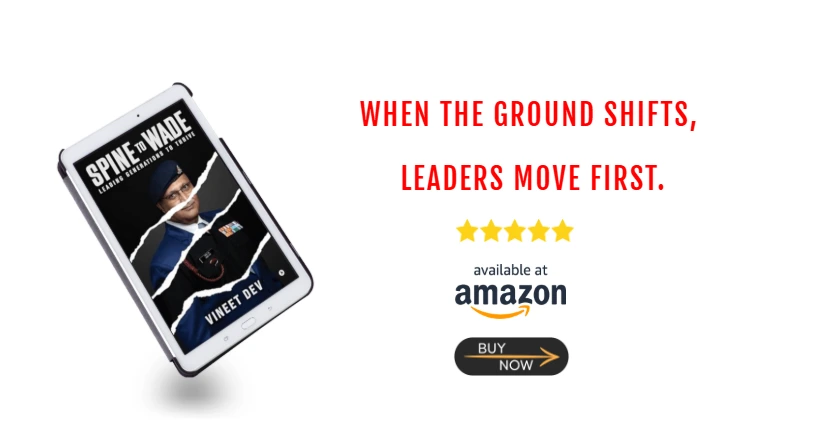
In Spine to Wade: Leading Generations to Thrive, Vineet Dev does not speak as a theorist observing leadership from a distance. He writes as someone who has lived through evacuations, political volatility, fractured organizations, and decisions that carried irreversible consequences. In this extended interview-style feature, Dev discusses the moments that shaped his thinking, the values that anchor his leadership framework, and why modern organizations need fewer performers and more stewards.
Q1. What finally convinced you that this book needed to be written now?
Answered by Vineet Dev:
The timing came from pattern recognition. Across decades in uniform and corporate roles, I kept seeing the same breakdowns when pressure increased. Communication collapsed, accountability blurred, and leaders became theatrical instead of decisive.
The pandemic years, geopolitical tension, and remote work acceleration simply exposed these cracks more visibly. I realized leaders were hungry for something that spoke plainly about chaos rather than pretending stability was the default condition.
Q2. The subtitle mentions “Leading Generations to Thrive.” Why was that emphasis essential?
Answered by Vineet Dev:
Because today’s teams include four generations working simultaneously. Each group brings different expectations around authority, flexibility, loyalty, and purpose. You cannot apply one leadership style universally anymore. But adaptability does not mean abandoning standards. The challenge is to preserve discipline while modernizing engagement. That balance — firmness without rigidity — became central to the book.
Q3. Why did you choose the phrase “Spine to Wade” as the title?
Answered by Vineet Dev:
Spine represents moral courage and structural stability. Wade implies movement through uncertainty rather than waiting for clarity. Leadership is rarely about clean leaps. Most of the time, you are moving through murky water, unable to see the bottom, carrying others with you. The title reflects that tension between steadiness and motion.
Q4. You describe evacuating eighty-seven people during a border shutdown. What did that episode teach you about leadership?
Answered by Vineet Dev:
It taught me restraint. When fear spikes, leaders often over-communicate or perform confidence theatrically. In that situation, calm logistics mattered more than speeches. Securing routes, negotiating permissions, rationing supplies, keeping morale intact without promising certainty — that was leadership. People were not watching for charisma. They were watching whether the plan held.
Q5. How did military service influence the way you view authority?
Answered by Vineet Dev:
The military strips away illusions quickly. Rank gives you responsibility, not obedience. You earn followership through consistency.
When bullets are flying, people follow those who have proven judgment, not titles. That lesson stayed with me in corporate life. During restructurings or crisis calls, employees are measuring whether you protect them or posture.
Q6. The values of Naam, Namak, and Nishaan run throughout the book. How did they emerge?
Answered by Vineet Dev:
They emerged organically from observation.
Naam — honour — governs personal conduct.
Namak — loyalty — defines how teams hold together.
Nishaan — legacy — forces leaders to consider what remains after they leave.
When leaders compromise honour, loyalty erodes. When loyalty erodes, legacy becomes hollow. Those three ideas form a chain.
Q7. You are critical of what you call “performative leadership.” What does that mean to you?
Answered by Vineet Dev:
Performative leadership focuses on optics rather than outcomes. It is the executive who gives motivational speeches but avoids tough decisions. The manager who launches initiatives but abandons accountability. The leader who manages perception rather than reality. In crisis, performance collapses. Only preparation and character remain.
Q8. What mistakes do organizations commonly make when working with Gen Z and Alpha professionals?
Answered by Vineet Dev:
They oscillate between two extremes: micromanagement or indulgence. Younger professionals crave autonomy, but they also want clarity. They want feedback without surveillance and structure without suffocation. The best leaders set firm expectations and then step back — remaining available but not oppressive.
Q9. How did you balance storytelling with instruction in the book?
Answered by Vineet Dev:
Stories create memory. Principles provide tools. I would narrate an incident — a stalled supply chain, a midnight call, a stranded team — and then slow down to dissect the decision-making process.
Why did we choose that route?
What risks did we accept?
What alternatives did we reject?
That reflection transforms anecdote into lesson.
Q10. Many readers see the book as autobiographical. How personal was the writing process?
Answered by Vineet Dev:
It was deeply personal, but not confessional. I was careful not to glorify moments or sanitize mistakes. Some of the hardest lessons came from errors — from acting too late or trusting the wrong signals. Owning those failures is part of responsible leadership writing.
Q11. How do you personally define success as a leader today?
Answered by Vineet Dev:
Success is invisibility. If the system functions when I am absent, if people step into responsibility rather than waiting for permission, if ethical lines hold under stress — that is success. If everything collapses when I leave the room, I have failed.
Q12. What surprised you most while writing the book?
Answered by Vineet Dev:
How similar crises look across industries. A stalled military convoy and a failing merger involve the same human reactions: fear, rumor, paralysis, territorialism. Once you recognize those patterns, leadership becomes less mystical and more disciplined.
Q13. How do authors today ensure serious leadership books reach the right readers?
Answered by Vineet Dev:
Publishing is only one stage. Strategic book marketing and author branding services play a crucial role in positioning non-fiction titles for executives, entrepreneurs, and academic audiences. Impactful ideas need visibility, otherwise they remain locked inside pages.
Q14. What do you hope readers ask themselves after finishing Spine to Wade?
Answered by Vineet Dev:
I hope they ask:
Would my team stand if I disappeared tomorrow?
Have I built systems or dependencies?
Do people follow me because they must or because they trust me?
Those questions define legacy.
Q15. Are there particular chapters you believe readers should linger over?
Answered by Vineet Dev:
Yes — the evacuation chapter, the generational leadership section, and the chapter on quiet decision-making. Those three show leadership at its most exposed: under threat, under transition, and under isolation.
What Readers Say
Feels like being briefed before walking into a crisis. – Sameer Khurana
Gripping and deeply practical. – Nidhi Chatterjee
A rare blend of humility and authority. – Rajat Mehta
This book should be mandatory reading for managers. – Anusha Pillai
Frequently Asked Questions
Is this book suitable for students or early-career professionals?
Yes. It offers foundational leadership habits without corporate jargon.
Does the book focus more on military or corporate experience?
Both, drawing lessons that translate across sectors.
Is this a motivational book?
It is more operational than inspirational, focused on decision-making.
Will Vineet Dev write more books?
He has indicated interest in expanding this leadership series.
